



The Crown Estate: InvestigationTime?
by TIM HICKS
~~~~~
Introduction
The Crown Estate is a portfolio of property worth about £15.6 billion that belongs to the monarch in his or her capacity as the reigning monarch, but which is not the monarch’s personal property.
The Crown Estate in England Wales and Northern Ireland is managed by the Crown Estate Commissioners. The Monarch plays no part in the management of The Crown Estate and has no control over its affairs.
According to The Crown Estate’s website: https://www.thecrownestate.co.uk/ grandiosely headed “Lasting and shared prosperity for the nation”, The Crown Estate is:
“an independent business sitting between the public and private sectors, acting in the national interest both today, and for future generations. Across communities, countryside, coast and seabed, we own and manage land for the benefit of the nation.”
The question, therefore, arises – why has The Crown Estate allowed members of the Royal Family to live in major properties at peppercorn rentals (i.e. for free), when, if rented out on a commercial basis, they would generate significantly more income for the public purse?
Andrew Mountbatten-Windsor and Royal Lodge.
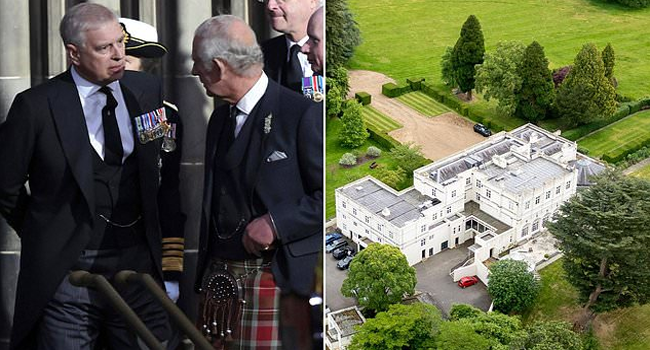
As I am sure all of the NYE’s readers are aware, the disgraced Andrew Mountbatten-Windsor (pictured above) has lived in the thirty room Grade II listed building Royal Lodge (also pictured above) on the Windsor Great Park, which is owned by The Crown Estates. It dates from the 19th century and was previously home to King George the VI before he became Sovereign and then to his mother Queen Elizabeth the Queen Mother until her death in 2002. Both members of The Royal Family that I profoundly admire.
In August 2003, Mountbatten-Windsor was granted a lease by the Crown Estate for seventy-five years, on the basis that he would refurbish Royal Lodge at his own expense (estimated cost of £5 million plus VAT) and pay £2.5 million pounds in lieu of future rent and a premium of £1 million pounds. Thereafter, he would pay a peppercorn rent (i.e. more or less nothing). So essentially the equivalent of a rent of about £120,000.00 – £140,000 per year in 2003 prices.
To put this in context, as a result of the Epstein scandal, Mountbatten-Windsor has been forced to move out of Royal Lodge. Media speculation indicates that the rentable value of Royal Lodge will be about £1 million a year, once Mountbatten-Windsor has moved out and it has been refurbished.
Its value in 2022 was estimated at £30 million. Although because of its size, status as a Royal residence, location within Windsor Great Park, this would not be a standard commercial transaction, so this figure can only be taken as an indicator. However, it is quite clear that Mountbatten-Windsor obtained Royal Lodge at far less than if it had been a commercial arm’s length transaction to an unconnected third party. Needless to say, there were no subsequent reviews to consider if this remained an equitable arrangement for The Crown Estate i.e. the taxpayer. So the initial arrangement stayed in place without being challenged or questioned by anyone.
It took the furore over the Epstein to expose this arrangement, which in my view should never have been entered into by The Crown Estate.
Why were the repairing covenants of the lease not enforced?
The next question to arise is why did The Crown Estate allow Mountbatten-Windsor to let Royal Lodge – a Grade II Listed Buildiing – fall into poor condition?
As with most leases there were repairing covenants which forced Mountbatten-Windsor to keep Royal Lodge in good order and to allow inspection by The Crown Estate to ensure he was meeting his obligations. It is unclear if these inspections were performed and if they were, why Mountbatten-Windsor was allowed to let the property fall into disrepair.
Following the public outcry against Prince Andrew, he has been forced to leave Royal Lodge. Under the 2003 agreement, he could have been entitled to compensation for an early surrender of the lease. However, a report from The Crown Estate to MPs on the Public Accounts Committee has confirmed that the property is dilapidated and in need of major repair. So as a result of his breach of the lease, it appears that no compensation will be paid because of the neglected state he left Royal Lodge in. No doubt The Crown Estate, i.e the taxpayer will have to pay for many of the refurbishments to bring it back to rentable condition.
Other Royals who benefit from subsidized housing from The Crown Estate
The third question that arises is a wider one. Which other members of the Royal family benefit from partial and one-sided property agreements with The Crown Estate.
Mountbatten-Windsor’s daughters Princess Beatrice and Princess Euenie are not working royals. They pursue separate and independent commercial careers, which is their choice. However, they both benefit from Grace and Favour properties. Eugenie lives in Ivy Cottage, Kensington Palace; Beatrice lives in St James’s Palace, both subsidized by the taxpayer through The Crown Estate.
Both women are wealthy in their own right, in well paid jobs and able to afford suitable accommodation of their own. So why should we have to subsidise their housing?
Prince Edward pays a peppercorn rent to The Crown Estate for the 120 room mansion Bagshot Park a Grade II listed mansion. In 1998 The Crown Estate leased Bagshot Park to Prince Edward for 50 years, following refurbishments that cost £2.980,000, of which Prince Edward paid £1.380,000.00. He then rented it from The Crown Estate initially for £5,000.00 a year then £90,000.00 a year after the renovation.
In 2007, this equitable and acceptable arrangement changed. He paid £5,000,000 for a 150-year lease and a peppercorn rental. Clearly this is not an at arms length, commercial transaction. The Crown Estate is subsidizing his accommodation.
Why should this be, given that he receives a grant from the Sovereign grant, which should be enough for him to finance his own housing?
The role of The Crown Estate
The Crown Estate was established by the Crown Estate Act of 1961, which requires that:
“the Commissioners shall not sell, lease or otherwise dispose of any land of the Crown Estate, or any right or privilege over or in relation to any such land, except for the best consideration in money or money’s worth which in their opinion can reasonably be obtained,”
Although it is supposed to be independent and commercial and holds itself out as such. It is clear that:
- Crown Estate Commissioners have entered into transactions with members of the Royal Family that disadvantage the taxpayer, over many years.
- Millions have been siphoned out of the public purse through subsidized housing for members of the royal family.
- The Commissioners have not operated within its duties as defined above.
There is a very strong argument for
1. an investigation into the above arrangements with members of the royal family and
2. action to be taken against the Commissioners who allowed these arrangements.
The wider concern, of course, is that there could be other subsidised housing agreements that we are not even aware of.
More from the North Yorks Enquirer
 Death of Jaysley Beck: Follow-Up
 Mountbatten Windsor: What Next? (Pt 2)
  Spotlight on Burglary
 Police Prevented from Investigating Police
 Police 7: Community Policing News Aug. ’25
 NYP Policy on Policing Events
- Police 7: Community Policing News July ’25
 NYP Custody Scandal Revisited
- The Death of Jaysley Beck
 The Dangers of Party Loyalists

